
 by Canton
September 8, 2026
by Canton
September 8, 2026
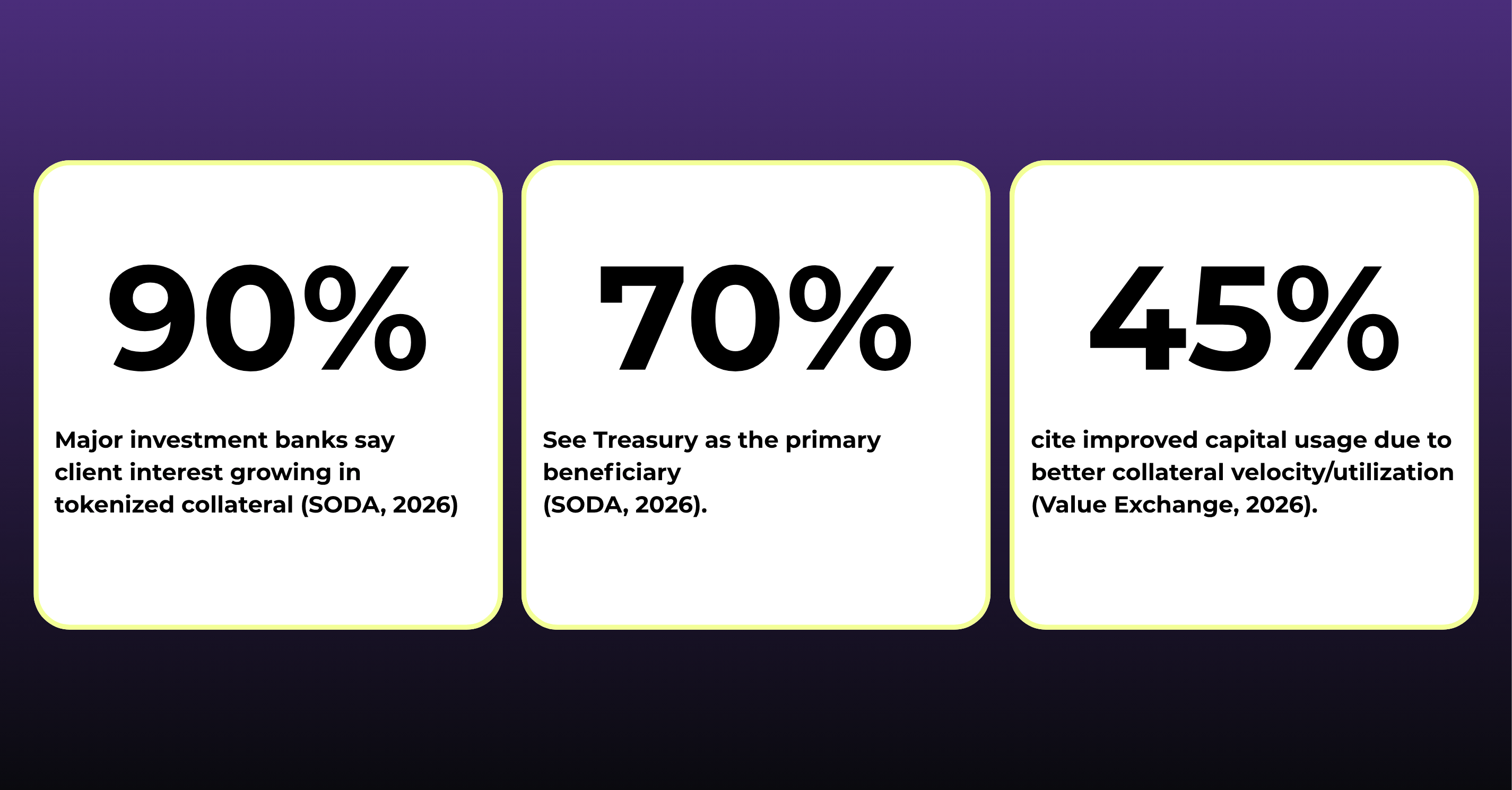
Collateral mobility and onchain repo is the clearest, highest value use case for tokenization, according to leading investment banks. In SODA’s new Tokenization survey,1 90% of investment banks see this significantly reshaping liquidity management within five years.
With production trades, proven technology and growing momentum, onchain collateral is no longer a ‘someday’ wish:
- DTCC and 30+ market participants completed live production trades, taking asset tokenization and onchain collateral/repo and financing from hypothesis to market reality.
- The business case offers tangible, measurable benefits leading to an increase in funding and business ownership within major institutions.
- The all-important cash leg onchain is being solved, giving market participants a variety of payment and financing options on atomic, 24/7 rails.
- Market adoption is accelerating, within a rapidly growing, interoperable ecosystem of service providers, solutions and connected financial institutions.
- Buyside client interest and demand is growing, with clear revenue and balance sheet opportunities emerging.
“With tokenization and repo done on the Canton Network, you can do a repo for four hours. You can do a repo over the weekend. A lot of time, treasurers have money come in late in the day. The ability to manage money around the clock as opposed to doing it once a day is a benefit for the full ecosystem.”
Steven Hood, Head of Clearing, Americas, Marex2
Hypothetical no more: DTCC unlocks tokenized assets in live production trades
In July, DTCC completed live production trades using tokenized U.S Treasuries, equities and ETFs in complex collateral, margin and securities financing transactions.
"DTCC successfully showcased how tokenization can enable real-time collateral mobility, enhance liquidity and capital efficiency, reduce counterparty risk and support interoperability between traditional and digital ecosystems.”
Brian Steele, President of Clearing & Securities Services, DTCC
Critical daily capital markets transactions were completed onchain, on Canton.
- Cash/market purchases and sales, including DVP transactions using Treasuries, equities and ETFs against on-chain cash. The asset and payment legs settled immediately.
- Intraday U.S. Treasury repo, with transactions lasting ~15-20 minutes instead of a 1-day minimum. Tailored repo terms allow for more precise funding based on actual liquidity needs.
- Securities lending, with tokenized assets used to meet financing requirements through the seamless, instant transfer of high-quality liquid assets.
- Real-time margin delivery using USTs that were tokenized, transferred to institutional wallets, and then delivered to the exchange to meet margin calls intraday.
When DTCC launches its Tokenization Service this October, a portion of its $114T in assets will be available for use in onchain transactions across Canton. DTC participants will be able to convert securities between traditional and tokenized form on demand and move collateral in minutes.
“We acted as the lender in an intraday securities lending transaction involving US Treasuries tokenized by the DTCC Tokenization Service. By connecting our own node to the Canton Network, we were able to demonstrate the seamless, instant transfer of high-quality liquid assets in a production-like environment.”
Stephane Pellerin, Head of Securities Services, Derivatives Execution & Clearing and FX Prime Brokerage Anericas, BNP Paribas3
The business case is clear
SODA data shows that the business case remains driven by an internal risk and economic transformation story. Two-thirds of investment banks expect the bank to use its own collateral and liquidity drivers more intelligently, and 70% see Treasury as the primary beneficiary.
“The business objective is directly linked to liquidity ratios and liquidity buffer management. We expect to have functionality later in the year that could affect liquidity buffers and enable more frequent trading to reduce those buffers. This is where tokenization becomes economically relevant: it can support more precise, intra-day management of liquidity and collateral.”4
Benefits come from unlocking billions in trapped capital, reducing over-collateralization and optimizing funding of intraday repo, improving key banking metrics like LCR, RWA and NSFR.
- 70% expect improved liquidity usage/LCR
- 45% cite improved capital usage due to better collateral velocity/utilization
- 25% say reduced funding costs/interest expense/cost of carry5
This aligns to other market research, which shows investment banks, private banks and custodian banks running DLT projects to drive treasury benefits from improved intraday liquidity, and the increased velocity and utilization of cash and collateral. According to The Value Exchange, collateral tokenization is set to become the largest institutional activity for 27% of firms in 2027. Over 50% of FMIs and 39% of banks expect to tokenize securities in 2027.6
The cash leg
Cash mobility is also critical, with onchain cash taking the form of tokenized deposits and stablecoins - underpinning the full value unlock of the onchain collateral use case.
Just as in traditional markets, there’s no ‘one-size-fits-all’ solution.
- 32% of banks (including custodians and tri-party agents) expect to receive stablecoins as collateral/margin in 2026.7
- Major institutions like HSBC, JP Morgan, Lloyds and LSEG are pursuing tokenized deposits for use in settlement8 across Canton.
- Market infrastructure firms are also prioritizing the use of debt and tokenized money market funds for margining9, with investors also focused on the utility of tokenized money market funds.10
The good news is that all these options are already available onchain. Based on preferences and requirements, market participants can choose from privacy-enabled stablecoins, tokenized deposits and tokenized money market funds on Canton today.
What about adoption?
The puzzle pieces are falling into place. Across the board, adoption is the critical path – it was universally cited by participants in the SODA survey and 92% of respondents in the 2026 Value Exchange DLT report.
“To work at scale, counterparties, custodians, FMIs, triparty agents, settlement platforms and other banks must be willing to use the same or interoperable infrastructure.”11
As the market infrastructure for the world’s largest market, DTCC has the size and scale to move the needle when it comes to adoption. Its Tokenization Service connects seamlessly with apps on Canton Network’s interoperable infrastructure to enable atomic, synchronized transactions. This opens the door for every DTC participant and service provider to participate in and drive value from onchain capital markets.
During the July trades on Canton, participants retained full control over the privacy of their transactions, collateral holdings and inventory. That’s BAU operations for Canton, whose ecosystem currently numbers hundreds of organizations from leading financial institutions to exchanges, custodians, wallet providers, and more.
“Platforms must fit into a highly complex bank and market ecosystem.”12
Canton is used at scale already today, processing $9T+ in tokenized real-world assets monthly. Counterparties connect and transact, confident that Canton provides the controls demanded by regulated markets.
“With Canton, firms can access public blockchain while retaining complete control over the privacy of their collateral holdings and inventory…each transaction and data item can be individually permissioned, meaning that asset holders retain the privacy that is so critical to their trading.”13
Growing commercial interest
While internal risk and economic transformation remain the key driver of the business use case, 90% of major investment banks report growing client interest. The SODA data shows 33% of respondents citing client demand in the fund/build rationale, and 37% able to identify revenue opportunities.
“The business is moving from fiat rails to digital rails, and you need to be in that ecosystem if you’re going to keep doing business with the clients that you currently do business with.”14
With the US market now moving to production and adoption, other jurisdictions are looking to apply similar models to bonds too (Canada, Europe and Japan). Cross-border collateral exchanges and securities lending trades are also being discussed.
Onchain collateral is no longer looking for a business case. Transactions are happening. The economics are measurable. The assets and infrastructure are available. And the network connecting collateral, financing and settlement is in production.
The question is not when will collateral move onchain? But how much value are you leaving locked up while you wait to take part?
Already a DTC member, client of a member, or interested in providing services across the emerging global collateral network on Canton? Get started here.
References
1. Tokenization at Investment Banks Survey, 2026, SODA. Request the report.
2. Atomic Settlement, Realized. July 2026 video, DTCC
3. Real Assets, On-Chain in Action. July 2026 video, DTCC
4. Tokenization at Investment Banks Survey, 2026, SODA. Request the report.
5. Tokenization at Investment Banks Survey, 2026, SODA. Request the report.
6. DLT in the Real World 2026, Key Findings, The Value Exchange
7. DLT in the Real World 2026, Key Findings, The Value Exchange
8. DLT in the Real World 2026, Key Findings, The Value Exchange
9. DLT in the Real World 2026, Key Findings, The Value Exchange
10. Tokenization at Investment Banks Survey, 2026, SODA. Request the report.
11. Tokenization at Investment Banks Survey, 2026, SODA. Request the report.
12. Treasuries On-Chain: An industry case for change,2025, The Value Exchange
13. Tokenization at Investment Banks Survey, 2026, SODA. Request the report.
14. Tokenization at Investment Banks Survey, 2026, SODA. Request the report.
15. Tokenization at Investment Banks Survey, 2026, SODA. Request the report.
Stay connected with Canton. Subscribe to our newsletter.
Sign me up
