
 by Canton
July 15, 2026
by Canton
July 15, 2026
Capital markets are moving onchain, and the finale of Quadrillions asks who leads the next system, and on whose rails.
Fast-moving fintechs such as Stripe, Robinhood, Revolut, Nubank and Coinbase are pushing first, while incumbents like Goldman Sachs, the DTCC and Euroclear build the plumbing underneath.
The scale of what is already digital is easy to overlook: Zelle cleared more than $1.2 trillion in 2025, and Coinbase lists 300 to 350 assets directly.
The season's thesis is that institutional adoption was always about more than technology: regulatory clarity, privacy and incentives that reward whoever drives real usage are key.
The following is a recap of key themes from the conversation. For the full discussion, watch the finale here.
The Voices Behind the Finale
The finale gathers three vantage points on the same shift.
Nick Shalek, a General Partner at Ribbit Capital, has helped back Nubank, Coinbase, Robinhood, Stripe and Revolut.
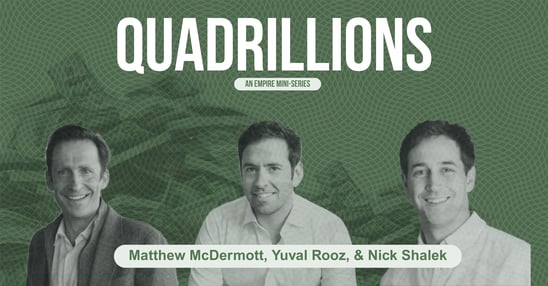
Goldman Sachs' Global Head of Digital Assets, Mathew McDermott, joined the bank in 2005 and previously ran cross-asset financing.
Yuval Rooz co-founded Digital Asset, which built the Canton Network, and earlier traded at Citadel and DRW.
Hosted by Jason Yanowitz of Blockworks, the conversation converges on the premise that permissioned and permissionless systems are symbiotic, and the winners will be those moving genuine volume onto shared rails.
Core Friction
For Mathew, the technology long felt like a solution searching for a problem, full of proofs of concept that never reached production scale. The missing ingredient he returns to is regulatory clarity.
"What breeds confidence is that seeming regulatory clarity." — Mathew McDermott, Global Head of Digital Assets, Goldman Sachs.
Nick put it more sharply: it does not pay to innovate when the move is risky for an incumbent and no competitor forces the issue. As evidence, he pointed to real-time payment rails: India's UPI and Brazil's Pix scaled because governments mandated them and took on the risk for banks, while America's FedNow has seen slower relative uptake.
He recalled how T+2 settlement nearly bankrupted Robinhood during the GameStop crisis.
"The incumbents largely move when they have to. They're natural second movers." — Nick Shalek, General Partner, Ribbit Capital.
How Canton Closes the Gap
For Yuval, Canton was built to fix those misaligned incentives directly, rather than to bet on regulation catching up.
It was not built around the GENIUS Act or the Clarity Act, since a business that depends on the law changing is fragile. The day-one thesis was that onchain finance at scale requires privacy, a claim that drew skepticism a decade ago but is now consensus.
"Building a business where you're relying on the law changing is not a good business model." — Yuval Rooz, Co-founder & CEO, Digital Asset.
Two design choices follow. Canton's economics borrow from credit-card networks where the infrastructure earns a modest margin at the base, while the builders who move the volume capture most of the economics.
That model lets them monetize through the volume they drive rather than by launching tokens of their own.
Governance runs through a foundation in which Digital Asset holds a single vote, with DTCC chairing the board alongside Euroclear, Goldman, other banks, exchanges and DeFi participants as members.
Composability is the payoff. A permissioned application, such as a life-insurance contract, can settle atomically with a permissionless asset like a stablecoin on one protocol. Yuval traced the name to the Swiss Cantons, which do not even spell the word the same way yet interoperate under one country.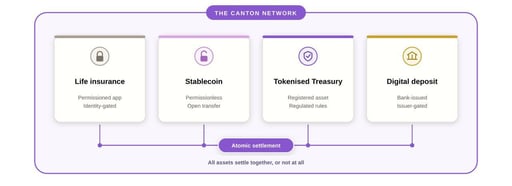
Figure: Heterogeneous assets keep their own rules, yet settle atomically together on Canton.
Executive Insights
Goldman's own platform, GS DAP, is being built on Canton. Mathew listed the use cases that already work, collateral mobility, collateralized derivatives, securities finance and repo, with a separate, still-early track exploring stablecoins and digital deposits.
Nick pushed back with a good point: a pragmatic, incumbent-paced approach risks missing the assets and markets that do not yet exist. Pointing to Coinbase's widening catalog and to prediction markets, he argued consumers may reach financial services in unfamiliar ways, and urged builders to treat machines as participants rather than only humans and institutions.
"The future is going to be weirder than we think." — Nick Shalek.
Mathew didn't dismiss it. He argued that round-the-clock markets, interoperability, real-time pricing and settlement finality free up capital and liquidity, with wealth-management clients potentially among the largest beneficiaries.
"Wealth management clients are going to be some of the biggest beneficiaries of this technology." — Mathew McDermott.
The Outlook
Both guests aligned on the projection for where the industry is headed: onchain rails will continue to integrate, markets and risk management will run around the clock, and new asset classes will arrive on infrastructure a decade in the making.
Yuval's barometer measures utility instead of price.
"Look at how much utility gets added every day. Prices sometimes are a misleading indicator of where the industry is at." — Yuval Rooz.
Nick ended where Ribbit began. Billions of people now hold mobile phones and digital money, but the infrastructure underneath is not good enough for where it needs to go. Getting there will take the world's largest financial institutions, whose involvement he has always treated as inevitable.
The New Wall Street is taking shape on shared rails. Whether it becomes the old system running faster, or something we would not recognize, is what the next two years will decide.
Further exploration:
- Catch up on the full six-episode series at quadrillionspod.com.
- Ribbit Capital's Token Letter (the tokenization thesis Nick draws on in the episode).
- The Canton Network ecosystem and developer documentation.
- Goldman Sachs' GS DAP platform.
- Circle's launch of USDCx on Canton via xReserve.
______________
Quadrillions is a miniseries produced by Blockworks and sponsored by Canton Network. Listen to the full episode at quadrillionspod.com.
Disclaimer: Nothing on this show is a recommendation to buy or sell securities or tokens. Views expressed are solely those of the guests.
Stay connected with Canton. Subscribe to our newsletter.
Sign me up
