
 by Canton
June 18, 2026
by Canton
June 18, 2026
The CFTC oversees roughly $700 trillion in notional financial markets. That covers nearly every asset class that isn't a stock or bond, including rates, FX, credit, commodities, and equity derivatives.
Almost none of it has moved onchain at scale. The blocker was never the technology but the posture of the regulators themselves.
2025 changed that posture. After years of regulation by enforcement, the President's Working Group report landed at the end of July, the House passed the CLARITY Act the same month, granting the CFTC exclusive jurisdiction over digital commodity spot markets, and the SEC launched Project Crypto soon after.
Against that backdrop, the CFTC kicked off a 12-month Crypto Sprint to implement every recommendation in the Working Group report by August 2026: stablecoins as collateral, listed spot crypto with leverage on futures exchanges, and technical rule amendments across margin, clearing, settlement, and reporting.
This is what Caroline Pham and Yuval Rooz unpack in Episode 4 (Part 1): the changes that may finally make the U.S. the crypto capital of the world. For the full discussion, watch Episode 4 (Part 1) here.
The Voices Behind Episode Four (Part 1)
Episode four sits down with Caroline Pham, Acting Chairman of the CFTC, alongside Yuval Rooz, co-founder and CEO of Digital Asset.
Pham started her career as an intern in the CFTC's enforcement division and is now in her fourth tour at the agency. She spent the years in between at Citigroup, working through Dodd-Frank implementation from the regulated side. That dual perspective, institutional rulebook and bank operations, shapes how she runs the Crypto Sprint.

Rooz returns from Episode 1. His thesis on this episode: the largest near-term opportunity in capital markets is collateral mobility, and stablecoins backed by tokenized treasuries are the cleanest way to deliver it.
Regulation by Enforcement Was the Real Tax
Pham frames the prior administration's approach as an "allergic reaction to new technology". This was a posture in which even legally permissible activity carried an investigation risk that few public companies wanted to underwrite. This kept companies on the sidelines regardless of what was technically within the rules.
"The government is not there to pick winners or losers... We're here to make sure that the rules are clear, that the game is fair, that people are able to build, to grow, to use our markets for what is intended." — Caroline Pham, Acting Chairman, CFTC.
Rooz develops the point from the operator's seat. Elaborating that companies already had the rules they needed but were waiting for permission to actually use them.
"It's actually the posture, the positive posture. We're here to innovate. We're here to allow use of technology. That posture, in my opinion, is actually the biggest bolster of this space in the last year." — Yuval Rooz, CEO, Digital Asset.
Beneath the posture problem sits the issue of collateral inefficiency: only about 15% of eligible collateral globally gets used. This is largely due to the operational challenge of moving it efficiently on traditional rails. Firms are eager to mobilise more.
"Only about 15% of eligible collateral ends up being used. And it's not because people don't want to use more collateral, because moving collateral in an efficient and cheap-to-deliver way is not very possible today." — Yuval Rooz.
That single statistic highlights the size of the prize. Unlocking the remaining 85% dormant capacity gives every major dealer more room to trade, lend, and clear.
How Canton's Architecture Closes the Gap
The CFTC's existing rules on eligible collateral are technology-neutral. Treasury money market funds qualify whether they sit on paper, in a database, or on a blockchain. But the rail that could move them at the speed and with the controls that institutions require was missing.
Canton supplies that rail. Tokenized treasuries, tokenized cash and other onchain instruments settle atomically against derivatives positions, with confidentiality preserved between counterparties and full visibility for the regulator.
A clearing house can apply its existing collateral haircut framework, with cash at par, treasuries taking a small haircut, and less liquid assets at progressively heavier discounts, without changing its underlying risk apparatus. With Canton, the risk logic doesn’t change; only the wrapper does.
That is why Broadridge, a Canton ecosystem partner, is already running close to 10% of the U.S. repo market onchain, processing roughly $400 billion in repo per day. This activity is live, regulated and scaling today.
Executive Insights
Pham's Crypto Sprint moves in three steps: spot crypto with leverage live on futures exchanges by year-end, stablecoins and tokenized collateral live in cleared markets in early 2026, and a full technical rulebook rewrite by August 2026.
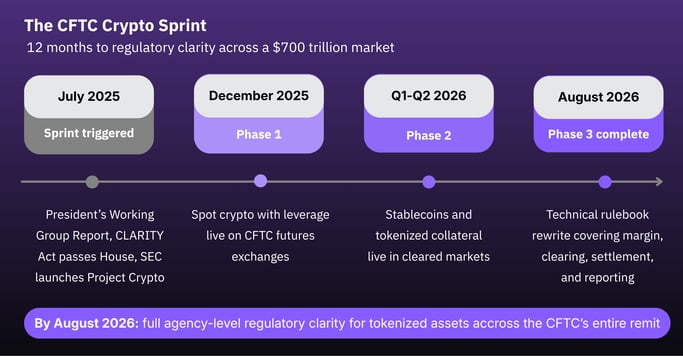
Figure: The CFTC Crypto Sprint, a 12-month path to regulatory clarity.
"For next year, I think that stablecoins will probably be live as collateral in cleared markets, like for our clearing houses, probably in the first or second quarter of next year." — Caroline Pham.
Rooz's strategic read is that scale is the only durable defense against regulatory reversal. Once enough real activity sits onchain, rolling it back becomes politically untenable. Essentially, it's the Uber and Airbnb playbook applied to capital markets.
“There is no putting the genie in the bottle anymore.” — Yuval Rooz.
The Outlook
The next twelve months are the operational window. Spot crypto with leverage clears the futures exchanges by December. Stablecoins enter cleared markets in early 2026. The technical rulebook is rewritten by mid-year. By the time the Crypto Sprint closes in August, the CFTC will have agency-level regulatory clarity for tokenized assets across its entire $700 trillion remit.
Next in the series: Episode 4 (Part 2) turns to stablecoins. Mohamed Afifi joins us to discuss fragmentation, privacy, and why most builders today are still rebuilding the same stack from scratch.
______________
Quadrillions is a miniseries produced by Blockworks and sponsored by Canton Network. Listen to the full episode at quadrillionspod.com.
Disclaimer: Nothing on this show is a recommendation to buy or sell securities or tokens. Views expressed are solely those of the guests.
Stay connected with Canton. Subscribe to our newsletter.
Sign me up
