
 by Canton
February 19, 2026
by Canton
February 19, 2026
Over the past year, Canton Network has gained rapid momentum, with $350bn+ of onchain assets processed daily and supported by a fast-growing ecosystem of wallets, custody providers and applications. Since the end of last year, average daily users of the network have more than tripled. This coincides with a huge rise in the number of applications coming to the network for its fast-growing institutional and retail user base, and privacy-enabled assets, transactions, and composability across applications.
This momentum has brought a rich diversity of wallet solutions - from self-custodial to fully custodial options, enterprise-grade to retail wallets, and hot or cold key storage - designed to meet the needs of a broad set of participants.
As the ecosystem has evolved, wallet choice has been initially shaped by application-specific integrations. Users interact through wallets supported by a given application, rather than being able to select one independently. Now, as the network enters its next phase of growth, enabling greater flexibility and interoperability across wallets and applications is an important next step to deliver a truly user-centric experience and scale with rising user demand and adoption.
At the core of unlocking this open developer experience is a new dApp API Standard (as specified by CIP-0103) - a foundational building block for application developers that now allows you to decouple the network connectivity of your application, from key management.
What is CIP-0103?
CIP-0103 is a standard interface specification that defines how decentralized applications (dApps) interact with the Canton Network. It standardizes the way applications connect to wallets, submit transactions, and listen for ledger events.
Conceptually, CIP-0103 is to Canton what EIP-1193 is to Ethereum, but adapted to the unique privacy-preserving, multi-domain architecture of the Canton Network.
Before CIP-0103, developers often had to rebuild fundamental primitives for every new application or wallet integration. CIP-0103 changes this by providing a unified framework that covers:
Connection: A consistent flow for connecting wallets to dApps.
Interaction: Declarative methods for signing and submitting ledger actions using a signing provider of choice.
Events: A uniform event model that allows dApps to react to ledger updates, such as contract creation or settlement completion, in real time.
Why CIP-0103?
As the Canton ecosystem grows, standardization ensures that users can interact with any application using their preferred wallet, and developers can build apps that work for everyone without custom code for each provider.
CIP-0103 enables:
For Wallet & Custody Providers:
- Expand user adoption: implement CIP-0103 once and interoperate seamlessly with a broad and rapidly growing ecosystem of Canton native apps and backends, making your wallet instantly available to users across multiple apps without bespoke integrations.
For User-facing Apps:
- Flexible user onboarding: allow users to connect through any wallet while signing transactions using their preferred custody method - whether that’s a self-hosted wallet, a cloud custodian, or a hardware device.
For Application Backends:
-
Enhanced developer experience: programmatically create, query, and manage contracts and transactions on the Canton ledger.
Ecosystem-wide Interoperability
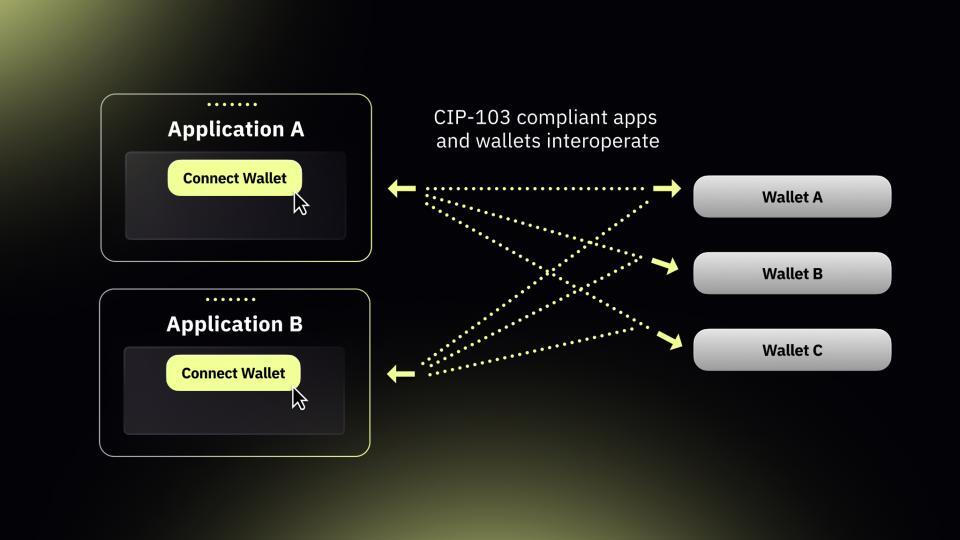
Just as CIP-0056 standardized how assets are defined, CIP-0103 standardizes how we interact with them. Leading ecosystem participants, including wallet providers, custodians, and application builders, are adopting the standard to ensure a cohesive user experience.
By aligning on CIP-0103, the Canton ecosystem moves closer to a "plug-and-play" environment where compliant apps and wallets can easily interoperate.
Ready to start building on Canton Network?
Take advantage of the dApp Standard today to create or upgrade applications that connect to the widest possible user base on Canton.
- Accelerate your Canton application development with Quickstart here.
- Read the Standard: Review the full technical specification in the official CIP-0103 proposal.
- Explore the SDK: See how easy it is to connect your application to the network via the dApp SDK on NPM.
- Learn how to integrate: Dive into the details with our developer documentation.
-
Join the community: Give feedback and see how others are leveraging CIP-0103 on our Developer Resources page.
Stay connected with Canton. Subscribe to our newsletter.
Sign me up
